

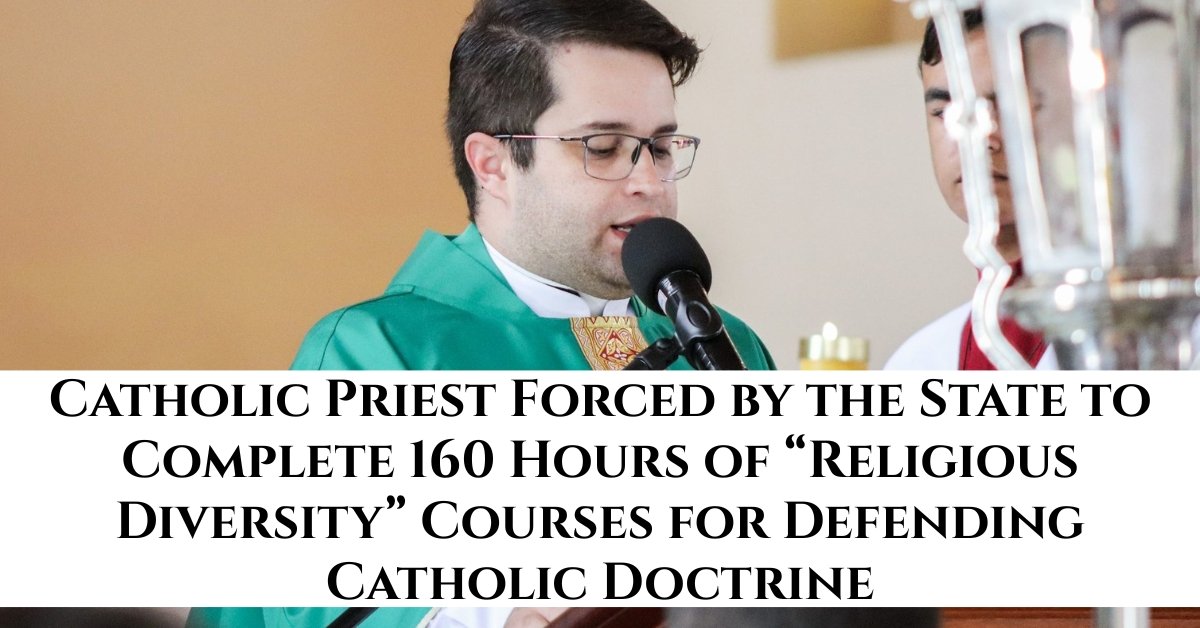
In July 2025, a Catholic priest in the Brazilian state of Paraíba did what priests have done for two millennia: he preached the faith of the Church from the pulpit. During a homily at the Parish of São José in Areial, Father Danilo César de Sousa Bezerra commented on the recent death of famous singer Preta Gil and a prayer offered by her father, Gilberto Gil, to the orixás (deities of Afro-Brazilian religions such as Candomblé and Umbanda). Within a clearly apologetic Catholic framework, the priest questioned the power attributed to those deities in the face of death and reminded the faithful that such practices are incompatible with Catholic doctrine. He referred to them as “occult things” and warned Catholics against seeking them.
The result? Accusations of “religious racism” and religious intolerance. No violence was incited. No one was called to attack practitioners of other faiths. The priest simply affirmed what the Church has always taught: that Jesus Christ is the only Lord, that false gods have no power to save, and that Catholics must not mix their faith with incompatible spiritualities.
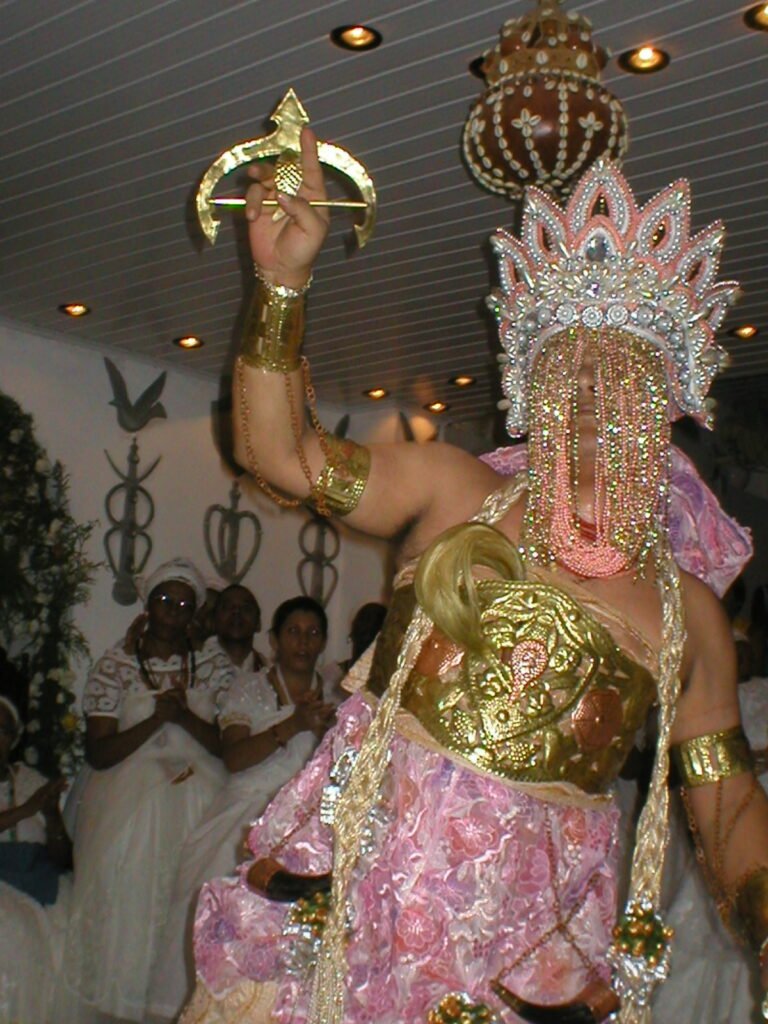
Photo:
A practitioner dressed as the orixá Obá in Brazil.
Yet the Brazilian state, through the Federal Public Prosecutor’s Office (MPF), treated this as a criminal matter. There was no formal conviction. Instead, Father Danilo accepted a non-prosecution agreement (ANPP) to avoid becoming a defendant in a criminal case. The conditions he was forced to fulfill are staggering in their absurdity:
- He had to complete 160 hours of courses on “religious intolerance and diversity” — studying a topic imposed upon him as if his Catholic formation were somehow deficient or hateful.
- He had to produce academic reviews of books and documentaries on the subject.
- He paid a sum equivalent to three minimum wages to an association supporting Afro-descendant communities.
- He participated in a public inter-religious act at the MPF headquarters in João Pessoa — an event involving representatives of Afro-Brazilian religions and members of the Gil family — which Brazilian commentator and legal analyst Ludmila Lins Grilo has rightly described as compelling a Catholic priest to take part in a demonstration linked to Umbanda practices.
- He was transferred from his parish.
As Ludmila Lins Grilo (a Brazilian former judge) powerfully analyzed on her program TV Injustiça on Youtube, this is not justice. It is institutional violence against religious freedom. A Catholic priest, exercising his sacred duty during Mass in a place of worship, was coerced by the state apparatus into studying, paying, publicly “repenting,” and even joining an inter-religious spectacle alien to his faith — all to avoid criminal prosecution for a religious opinion. There was no sentence because the process itself became the punishment. The weight of a potential criminal case for “racism” is so heavy that many simply submit. This is textbook lawfare: the use of judicial and prosecutorial power to silence those with whom one disagrees.
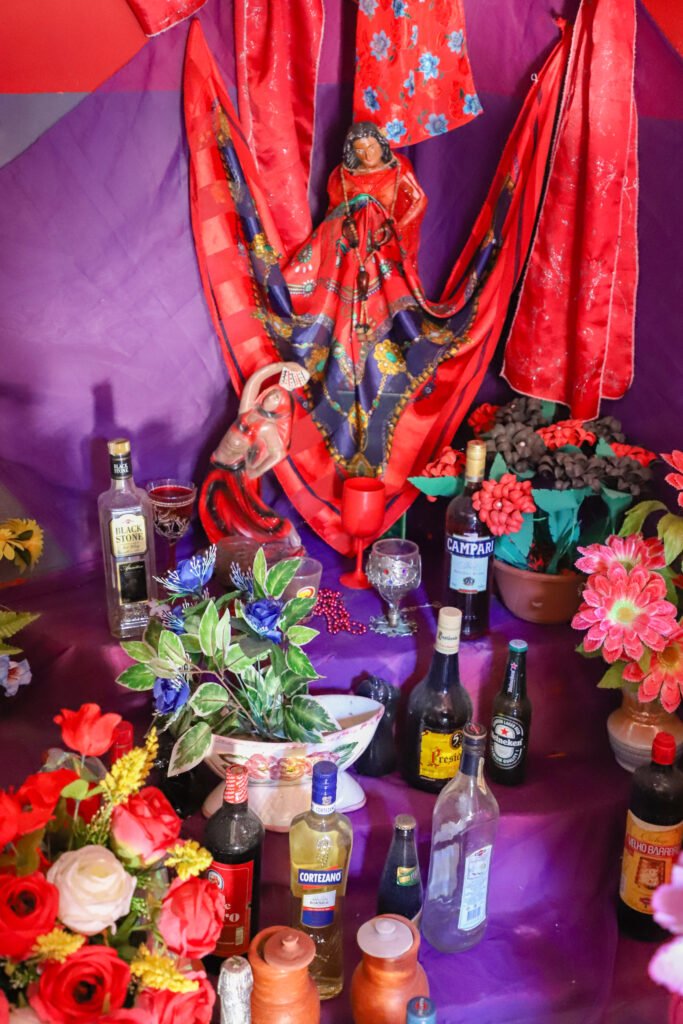
Ludmila correctly highlights the double standard. Would a practitioner of an Afro-Brazilian religion be prosecuted for publicly declaring that Catholic baptism has no spiritual value, or that the saints are powerless idols? Such statements are common in inter-religious debate and protected by genuine religious freedom. Yet when a Catholic priest affirms the exclusive claims of his own faith, the machinery of the state mobilizes. The Brazilian Supreme Court (STF) and Superior Court of Justice (STJ) have established clear parameters distinguishing legitimate religious proselytism from unlawful hate speech. According to those standards, the crime of religious racism requires specific elements — including intent to discriminate or incite violence — that were absent here. Father Danilo preached doctrine. He did not preach hatred.
Even more troubling is the relative silence of parts of the institutional Church. The local diocese issued a restrained, almost bureaucratic note reaffirming generic constitutional principles without robustly defending its own priest’s right to teach Catholic truth. Broader national Catholic bodies offered little public resistance. When the Church itself appears acquiescent, the chilling effect deepens.
A Wider Pattern of Pressure on Christian Clergy
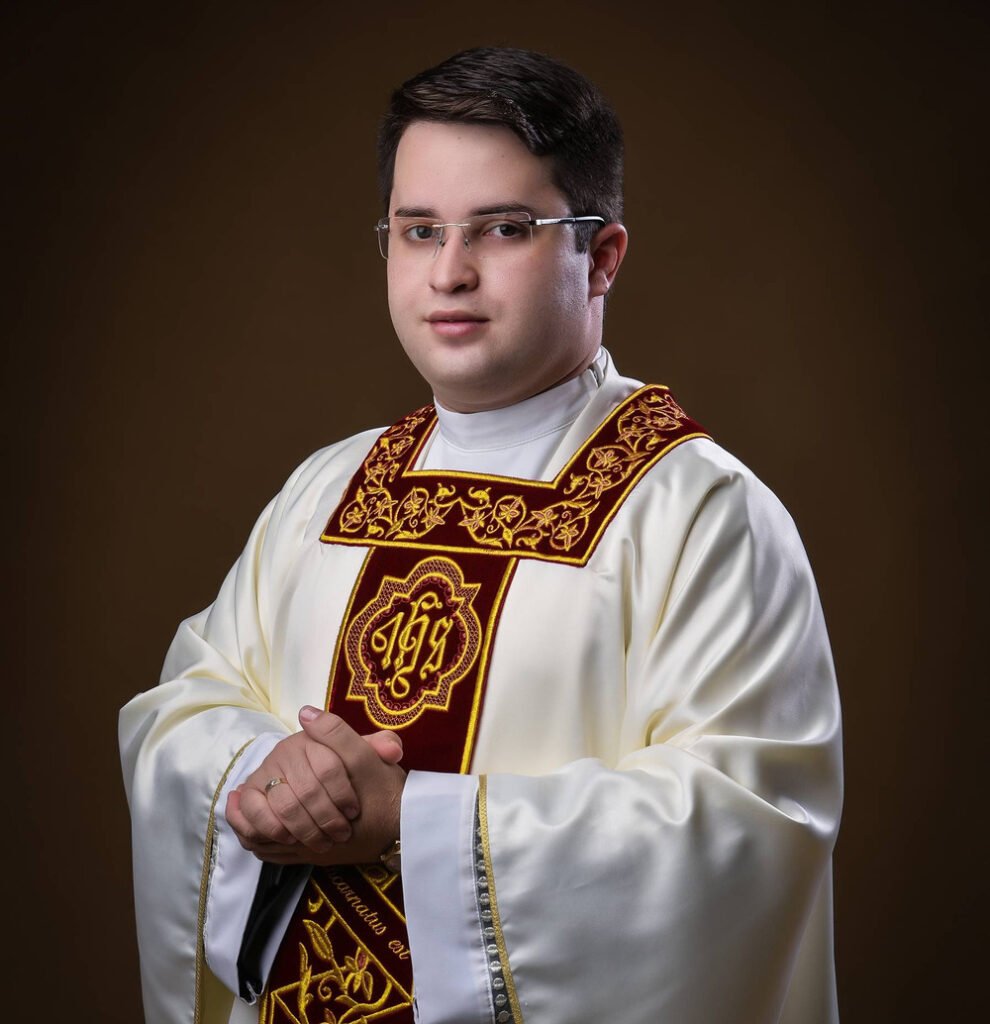
PHOTO:
Father Danilo César de Sousa Bezerra
This case does not stand in isolation. In Brazil, the concept of “racismo religioso” has increasingly been applied against Christian pastors and priests who publicly critique Afro-Brazilian religions as incompatible with the Gospel or associated with spiritual darkness. While physical attacks on terreiros (Afro-Brazilian temples) — often linked to certain evangelical factions or criminal groups in places like Rio de Janeiro — are real and rightly condemned, the legal and institutional pressure has disproportionately targeted Christian speech that simply upholds exclusive truth claims. Pastors have faced convictions or investigations for associating other religions with demonic influence or “witchcraft.” The reverse — prosecuting Afro-Brazilian leaders for denying Christian sacraments — is far rarer.
This trend has accelerated over the past two decades, intensifying with the growth of both evangelical Christianity and assertive campaigns framing criticism of Afro-religions as inherently racist. What began as cultural and social tension has increasingly entered the courtroom, turning doctrinal disagreement into potential criminal liability.
Looking beyond Brazil to Europe — a context especially relevant for readers in Norway — we see a parallel soft persecution of Christian expression that has grown markedly over the last 10–15 years and continues to rise. Reports from the Observatory on Intolerance and Discrimination Against Christians in Europe (OIDAC) document thousands of anti-Christian hate incidents annually: vandalism and arson of churches (nearly doubling in some recent years), assaults on clergy and faithful, and desecrations. In countries such as Poland, surveys indicate that nearly half of priests have experienced aggression. Legal mechanisms compound the problem: hate-speech laws have been used against politicians and clergy for quoting Scripture on marriage and sexuality (the long-running case of Finnish MP Päivi Räsänen is emblematic), silent prayer near abortion facilities has led to arrests in the United Kingdom, and traditional Catholic teaching on moral issues has triggered investigations in several nations.
This is not the bloody persecution of earlier centuries or of contemporary regions under Islamist pressure. It is a subtler, bureaucratic, and cultural form of constraint that treats orthodox Christian doctrine as suspect or harmful in the public square. It has roots in post-1960s secularization and has accelerated with progressive legal frameworks prioritizing certain protected identities over classical religious liberty. Christians who simply teach what the Church has always taught about God, salvation, and morality increasingly face social ostracism, professional consequences, or legal scrutiny.
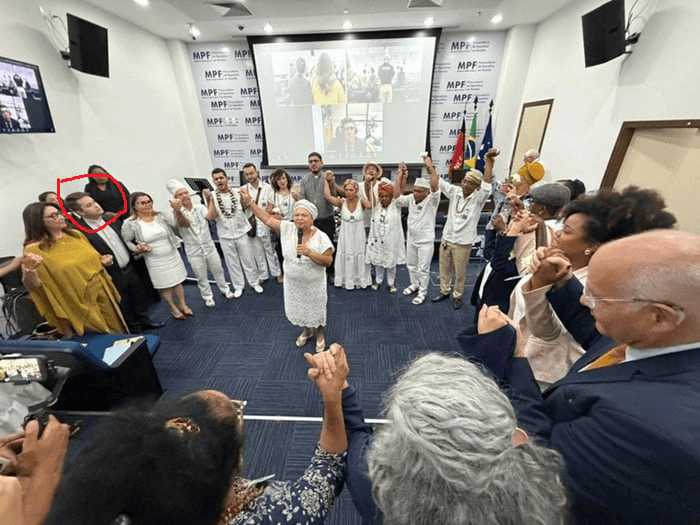
PHOTO
Father Danilo César is standing next to the participant dressed in yellow during an interfaith event in João Pessoa (PB), held as part of a non-prosecution agreement for “religious racism”.
Father Danilo’s case is a particularly clear and recent illustration of the absurdity: a priest forced by the secular state to undergo re-education, financial penalty, and symbolic participation in another religion’s framework merely for preaching Catholicism. Religious freedom is not the right to hold private opinions. It includes the right to proclaim one’s faith publicly, especially from the pulpit. When that right is subordinated to ideological notions of “diversity” or “anti-racism” that effectively silence exclusive truth claims, the result is not tolerance. It is coercion.
Catholics in Norway and around the world should take note. What happens to one priest in a remote Brazilian parish can become a precedent elsewhere. Faithful preaching of the Gospel must not be criminalized. We must pray for Father Danilo, for courage among clergy and bishops, and for the recovery of a true understanding of religious liberty — one that protects the right of every religion to teach its own doctrines without state-imposed re-education.
Christus vincit.