If you are a member of the Church of Norway (Den norske kirke), you may wonder why a growing number of Lutherans — including some pastors — are choosing to enter the Catholic Church. This is a respectful and honest question, and I will try to explain it in a simple way.
Jesus Promised to Build One Church
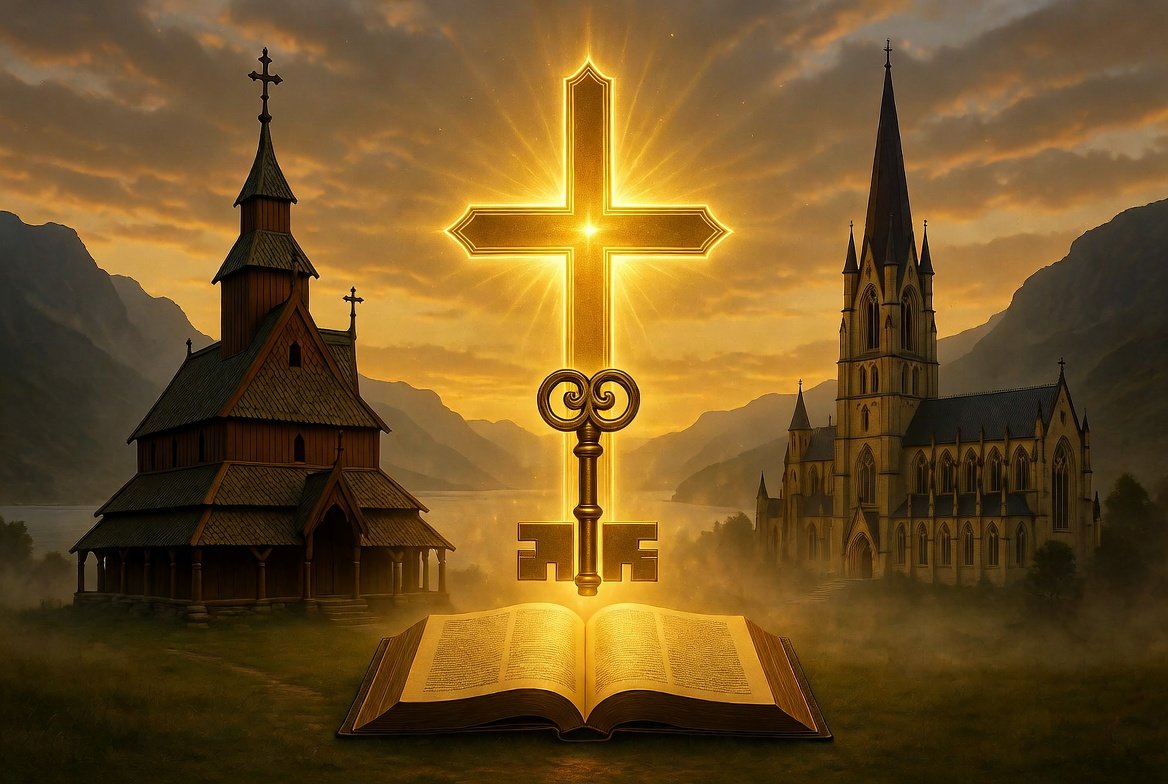
Jesus said to Peter:
“You are Peter, and on this rock I will build my church” (Matthew 16:18).
He did not say He would leave only a Bible for everyone to interpret in their own way. He founded one visible Church with real authority, and He promised that this Church would never be completely overcome.
For the first 1,500 years of Christianity, the Church in Norway — and everywhere in Europe — was Catholic. There was one faith, one baptism, and one leadership structure connected to the apostles.
What Changed in the 16th Century?
In the year 1537, the Reformation came to Norway. The king decided that the country would become Lutheran. The Church of Norway was born. Martin Luther and other reformers believed that many things in the Catholic Church needed to be corrected. They taught that the Bible alone (Sola Scriptura) should be the only authority.
At first, this seemed like a good idea to many people. But over the centuries, an important question has appeared:
Without a visible, living authority, who decides what the Bible really means?
The Result of “Bible Alone”
Today there are more than 40,000 different Protestant denominations in the world. Each group reads the same Bible but often reaches different conclusions about baptism, the Lord’s Supper, marriage, morality, and many other important matters.
This fragmentation is one of the main reasons some Lutherans begin to search deeper.
What Many Discover When They Study Church History
When people study the writings of the early Christians (the Church Fathers from the 1st to the 5th centuries), they often notice something surprising:
The early Church looked very Catholic:
- They believed in the Real Presence of Jesus in the Eucharist
- They had bishops, priests, and deacons
- They honored Mary and the saints
- They had a visible unity centered in Rome
Many Norwegian Lutherans who study these early writings come to the same conclusion: The Catholic Church is the same Church that Jesus founded — the one that has continued without breaking the line of apostolic succession for 2,000 years.
A Personal Search for Fullness
Those who convert usually do not hate their Lutheran background. Many of them say:
“I received a deep love for Jesus and the Bible in the Church of Norway. But I felt something was missing — the fullness of the sacraments, the historical connection to the apostles, and a clear, stable teaching authority.”
They are not running away from something bad. They are moving toward something they believe is more complete.
Testimonies from Norwegian Converts
Prof. Ola Tjørhom, a well-known Lutheran theologian and professor in Stavanger, converted to Catholicism in 2003. He explained:
“After many years of ecumenical work, I came to the conclusion that the Catholic Church is the Church that has preserved the apostolic faith in its fullness. The unity, the sacraments, and the historical continuity convinced me.”
Another former Lutheran pastor, Egil Mogstad, who was ordained in the famous Nidaros Cathedral, became Catholic and was later ordained as a Catholic priest. He said:
“I did not leave the faith I had. I found its fullness.”
Many Norwegian converts mention the same experience: they received a strong foundation in Scripture and love for Jesus in the Church of Norway, but they longed for the fullness of the sacraments, the historical depth, and a stable teaching authority.
Photo by
Photo by Jacob Bentzinger on Unsplash
A Message of Respect
If you are Lutheran and reading this, please know: Catholics do not believe that Lutherans are not Christians. We share the same baptism and the same Lord. Many good and holy people are in the Church of Norway.
But we also believe that Jesus wants all Christians to be united in one Church — the one He built on Peter.
This is why some Norwegian Lutherans, after careful study and prayer, decide to become Catholic. Not because they have rejected their past, but because they believe they have found the original home that Jesus prepared for all His followers.
As Jesus prayed:
“That they may all be one, just as you, Father, are in me, and I in you.” (John 17:21)